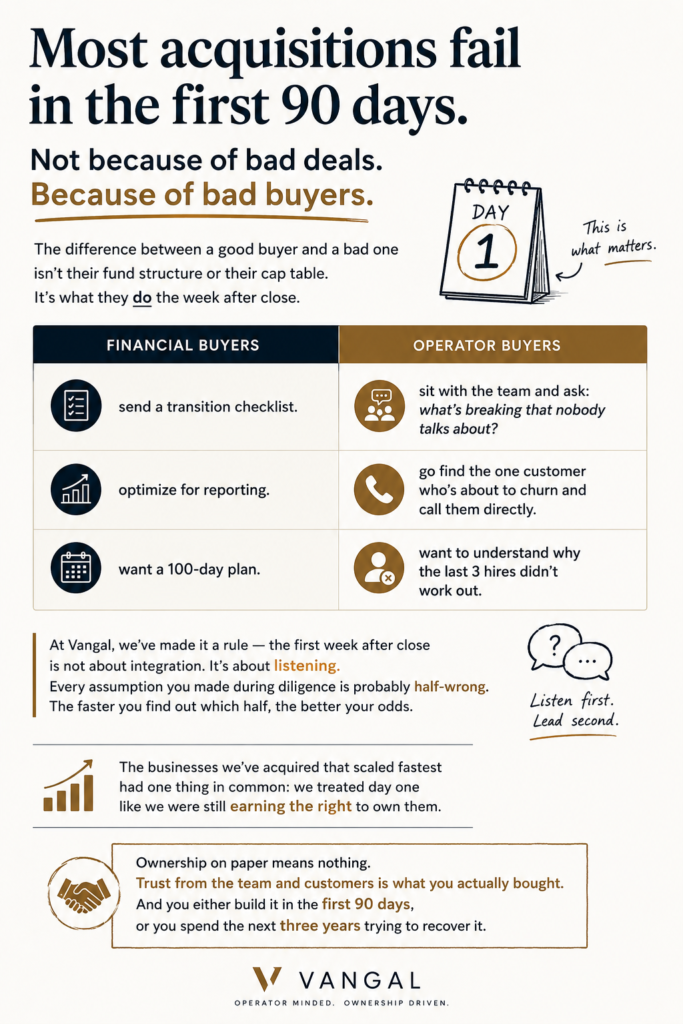
Most acquisitions fail in the first 90 days — not because of bad deals, but because of bad buyers.
The difference between an operator-led buyer and a financial buyer isn’t their cap table or their fund structure. It’s what they do the week after close. What good buyers do after acquisition is unglamorous, specific, and almost never discussed in deal teardowns.
I’ve bought businesses where I got this right and businesses where I didn’t. The pattern is consistent.
They Talk to Customers Before They Talk to Investors
Financial buyers celebrate the close. Operator buyers get on the phone with the top five customers the next morning. Not to pitch. To listen.
The goal is simple: understand why customers stay, what’s fragile, and what the previous owner promised that hasn’t been delivered yet. That information doesn’t live in the data room. It lives in those conversations.
Good buyers after acquisition treat day one as a discovery sprint, not a victory lap. The deal is done. The real work just started.
They Protect Revenue Before They Optimize Costs
The first instinct of a bad buyer is to cut. Headcount, tools, vendor contracts — anything that looks like fat on the P&L. It feels decisive. It’s usually destructive.
Operator buyers know that acquired businesses have hidden load-bearing walls. The contractor who “just does ops” is actually the reason three enterprise clients haven’t churned. The “redundant” software tool is what the support team uses to keep SLAs green.
What good buyers do after acquisition is map revenue risk before touching cost structure. A 10% margin improvement means nothing if it triggers 20% churn six months later. Sequence matters.
They Retain the Institutional Memory — Not Just the Founder
Most buyers focus on founder retention. Lock-ups, earnouts, transition agreements. That’s fine. But founders aren’t the only ones who hold critical knowledge.
The salesperson who closed the first 50 accounts knows things the founder has forgotten. The customer success lead who manually onboarded early customers built workarounds the product still depends on. Lose those people in the first quarter and you’ve bought a business with the wiring ripped out.
Good buyers identify the two or three people — often not in leadership — who carry tribal knowledge. They talk to them directly, early, and make them feel seen. That costs nothing. Losing them costs everything.
They Set Operating Metrics Before They Set Growth Targets
Financial buyers show up with a growth thesis. Operator buyers show up with a baseline question: what do we actually know?
In the first 30 days, the job is instrumentation, not acceleration. What’s the real churn rate — not the reported one? What’s the CAC by channel? What’s the support ticket volume by customer segment? Half the time, the numbers in the CIM don’t survive contact with the actual business.
What good buyers do after acquisition is resist the pressure to grow before they can measure. You can’t optimize what you can’t see. Chasing revenue targets on top of a broken data foundation is how you run fast in the wrong direction.
This is the operator-financial buyer divide in practice. One group moves fast on the things that feel important. The other moves deliberately on the things that are important — customers, people, measurement, sequence.
The best acquisition I’ve run started slow and compounded fast. The worst started fast and unraveled slowly. The discipline to do the unglamorous work in the first 90 days is exactly what separates buyers who build durable businesses from buyers who just buy them.