Most acquisitions don’t fail at close — they fail in the months right after it.
The first 6 months after acquisition are when value gets created or destroyed. Not during diligence. Not at signing. After. When the real business — the messy, human, operational reality — shows up and demands decisions.
Here’s exactly what changes, and when. This is based on what we’ve seen across multiple acquisitions at Vangal, not theory.
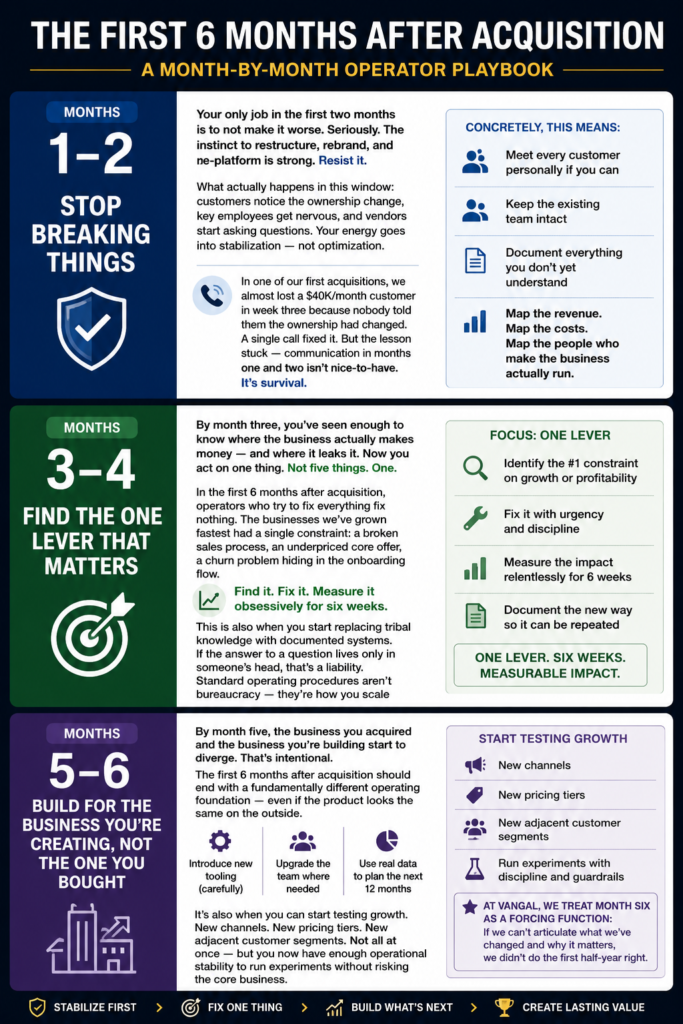
Months 1–2: Stop Breaking Things
Your only job in the first two months is to not make it worse. Seriously. The instinct to restructure, rebrand, and re-platform is strong. Resist it.
What actually happens in this window: customers notice the ownership change, key employees get nervous, and vendors start asking questions. Your energy goes into stabilization — not optimization.
Concretely, this means: meet every customer personally if you can, keep the existing team intact, and document everything you don’t yet understand. Map the revenue. Map the costs. Map the people who make the business actually run.
In one of our first acquisitions, we almost lost a $40K/month customer in week three because nobody told them the ownership had changed. A single call fixed it. But the lesson stuck — communication in months one and two isn’t nice-to-have. It’s survival.
Months 3–4: Find the One Lever That Matters
By month three, you’ve seen enough to know where the business actually makes money — and where it leaks it. Now you act on one thing. Not five things. One.
In the first 6 months after acquisition, operators who try to fix everything fix nothing. The businesses we’ve grown fastest had a single constraint: a broken sales process, an underpriced core offer, a churn problem hiding in the onboarding flow.
Find it. Fix it. Measure it obsessively for six weeks.
This is also when you start replacing tribal knowledge with documented systems. If the answer to a question lives only in someone’s head, that’s a liability. Standard operating procedures aren’t bureaucracy — they’re how you scale without the founder.
Months 5–6: Build for the Business You’re Creating, Not the One You Bought
By month five, the business you acquired and the business you’re building start to diverge. That’s intentional. The first 6 months after acquisition should end with a fundamentally different operating foundation — even if the product looks the same on the outside.
This is when you introduce new tooling (carefully), upgrade the team where needed, and start thinking about the next 12 months with real data instead of projections from an old pitch deck.
It’s also when you can start testing growth. New channels. New pricing tiers. New adjacent customer segments. Not all at once — but you now have enough operational stability to run experiments without risking the core business.
At Vangal, we treat month six as a forcing function: if we can’t articulate what we’ve changed and why it matters, we didn’t do the first half-year right.
The Pattern Across All Three Phases
Each phase has a distinct mode — stabilize, optimize, build. Most acquirers skip to build immediately and pay for it. They confuse owning a business with understanding one.
The first 6 months after acquisition are not an extended due diligence period. They’re the most expensive classroom you’ll ever pay for. The operators who respect that pacing build durable businesses. The ones who don’t spend the next two years firefighting problems they created themselves.
Speed of action matters far less than sequence of action. Get the sequence right, and the business compounds. Get it wrong, and you’re just the new owner of someone else’s chaos.