Most founders think there are two options: sell or keep grinding. There are at least five more — and most of them leave you better off.
When I’m evaluating businesses at Vangal, I often talk to founders who are exhausted but not ready to fully exit. They want liquidity, or relief, or both. Selling feels like the only answer because it’s the most visible one. It’s not.
Understanding the real alternatives to selling my business changes the entire decision. Here’s what actually works.
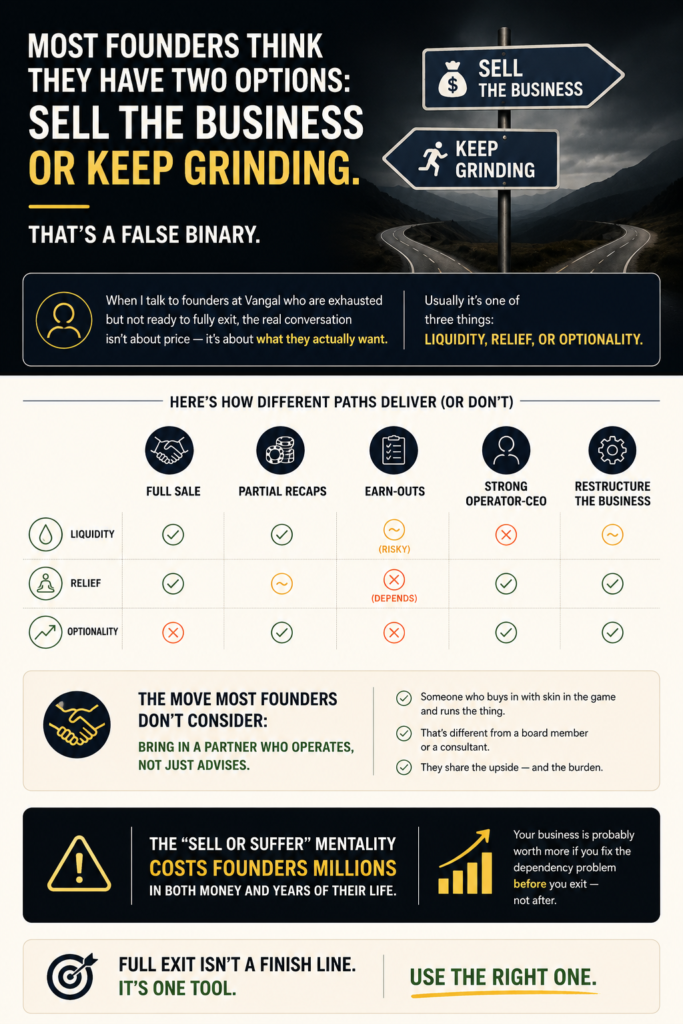
Partial Liquidity: Take Some Chips Off the Table
A full sale isn’t the only way to convert equity into cash. Minority recapitalizations — where a PE firm or investor buys a stake, say 30–60%, without taking control — let you extract real money while keeping upside in the business you built.
The tradeoff: you now have a partner with opinions. If you’ve run solo for a decade, that’s a real adjustment. But if the alternative is burning out and selling for less than the business is worth, partial liquidity is almost always the better math.
We’ve structured deals this way at Vangal. The founder gets relief. We get a stake in a growing asset. The business keeps its operator in place.
Hire a CEO, Stay as Owner
Operator fatigue is the number one reason founders explore alternatives to selling my business. They’re done with the day-to-day, not done with the asset. Those are different problems.
Hiring a strong operator — a GM or CEO — to run the business while you stay on as a capital-holding owner is underused and underestimated. Done right, you go from exhausted operator to passive equity holder without a transaction cost.
The hard part is the hire itself. Most founders either can’t afford tier-one operator talent or don’t trust anyone enough to hand over the keys. Both are solvable. Equity incentives and a structured transition period fix most of this.
Operational Restructuring Before Any Decision
Sometimes what looks like a “should I sell?” problem is actually a margin problem or a process problem in disguise. Founders run lean for years, never systematizing anything, and then hit a wall.
A structured operational review — looking at where time, cost, and revenue are actually going — often unlocks 20–40% efficiency without a transaction. Automate fulfillment. Cut the bottom 20% of clients that drive 80% of your stress. Restructure pricing.
This isn’t glamorous, but it changes what the business is worth and what it feels like to own it. The business that makes you miserable at $2M revenue might be genuinely enjoyable at $3M with the right structure. Selling a broken-feeling business also means selling it at a discount.
Earn-Outs and Structured Exits: The Middle Path
If you’ve decided to sell but are getting lowball offers, an earn-out structure is one of the most underutilized alternatives to selling my business outright at a depressed valuation.
Here’s how it works: you accept a lower upfront payment in exchange for performance-based payouts over 12–36 months. If the business hits targets post-acquisition, you get paid more — often significantly more — than the all-cash offer on the table today.
The risk is real. Earn-out disputes are common. The new owner controls conditions you don’t. You need clean contract language, defined metrics, and a buyer you actually trust. But for a business with strong growth trajectory and a skeptical buyer, this structure closes gaps that would otherwise kill the deal.
The point is this: alternatives to selling my business aren’t consolation prizes. They’re often smarter outcomes. A full sale is a one-time, irreversible event. Every other option preserves optionality. Founders who explore the full menu — partial liquidity, leadership hires, operational fixes, structured earn-outs — almost always end up in a better position than those who rush to the exit because they were too tired to think through anything else.
Exhaustion is not a valuation strategy. Slow down and look at all the options before you sign anything.