The agency world is massively underestimating what AI is actually going to do to services businesses because most people are still framing this as a tooling upgrade instead of an organizational redesign problem. The current conversation sounds almost identical to earlier waves of software adoption where companies assumed new technology would simply accelerate existing workflows. Faster reporting. Faster creative production. Faster research. Faster SEO execution. Faster onboarding. Faster media buying. But I increasingly think this framing misses the deeper issue entirely.
Most agencies were fundamentally built around coordination costs.
That is the part people miss.
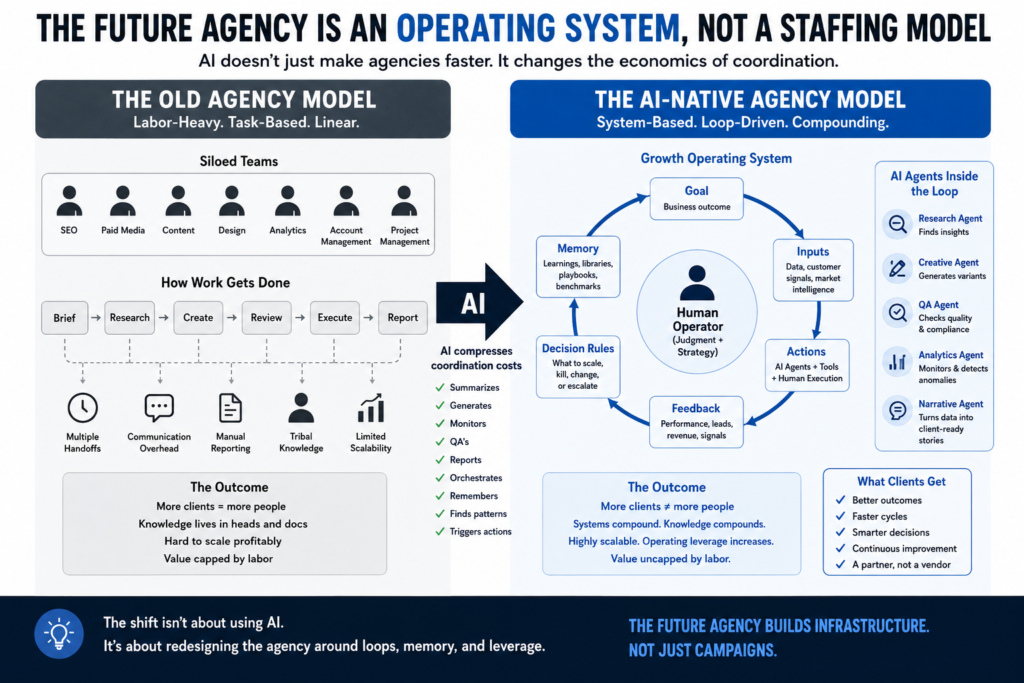
The modern agency org chart exists because, historically, moving information between humans was expensive and difficult. You needed specialists because channels became fragmented, tooling became complicated, data became difficult to aggregate, and execution required significant amounts of manual orchestration between teams. SEO people talked to content teams. Content teams coordinated with design teams. Design teams coordinated with paid media teams. Analysts prepared reporting for account managers. Project managers sat in the middle trying to ensure all these moving parts did not collapse into operational chaos.
That structure made complete sense in the internet and SaaS era because labor was the primary production engine inside agencies. Agencies essentially became coordination companies wrapped around specialized marketing labor.
AI attacks that assumption directly.
Not because it replaces humans outright, but because it dramatically lowers the cost of coordination itself.
When AI can summarize meetings, generate first drafts, monitor campaigns, QA deliverables, prepare reports, organize workflows, maintain persistent memory, generate creative variations, identify anomalies, and orchestrate actions across systems, a large percentage of what agencies currently spend operational energy on starts becoming software primitives instead of human processes.
This is why I think many agencies are accidentally misunderstanding their own business.
Most agencies think they sell marketing services.
In reality, many of them sell workflow coordination.
And workflow coordination is exactly what AI is beginning to compress.
The interesting thing is that this does not necessarily destroy agencies. But it absolutely changes what kind of agencies survive. The agencies that continue operating as labor packaging businesses are going to face enormous pressure because AI progressively removes friction from execution-heavy work. If your primary value proposition is “we have people who do tasks,” then AI steadily erodes pricing power over time.
But if your value comes from judgment, systems thinking, infrastructure, strategic prioritization, trust, speed-to-learning, and operational memory, the picture becomes very different.
That is where the next generation of agencies probably gets built.
I think the future agency looks less like a traditional services business and more like a managed operating system for growth.
That sounds abstract until you break it down operationally.
Today, most agencies still recreate work repeatedly. Every client onboarding starts semi-from-scratch. Every campaign requires new coordination layers. Every reporting cycle becomes another manual exercise in aggregation and interpretation. Institutional knowledge lives inside Slack threads, meetings, Notion docs, and the heads of operators who eventually leave the company.
That model does not compound very effectively.
The agencies that win in an AI-native environment will probably focus obsessively on compounding systems instead of isolated deliverables. Every campaign should improve future campaigns. Every onboarding should strengthen future onboarding. Every failed experiment should improve future targeting logic. Every report should improve future decision-making systems.
In other words, the real asset becomes operational memory.
This is where AI becomes much more powerful than “content generation” or “creative acceleration.” AI allows agencies to slowly transform expertise into infrastructure. Workflow logic becomes reusable. QA becomes systematic. Decision trees become persistent. Performance patterns become queryable. Institutional knowledge becomes portable instead of tribal.
That changes the economics of scaling an agency.
Traditionally, agencies scaled poorly because revenue growth required proportional headcount growth. More clients meant more delivery work. More delivery work meant more project management overhead, communication overhead, QA overhead, onboarding overhead, and coordination complexity. Organizational drag increased almost automatically with scale.
Infrastructure changes that equation.
Now one strategic operator can supervise systems that previously required entire functional teams. One creative lead can oversee agent-assisted content systems. One analyst can monitor automated insight pipelines. One strategist can coordinate multiple acquisition loops simultaneously without adding layers of operational management underneath them.
That leverage shift is very significant economically.
And honestly, this is where I think many people become uncomfortable because a large amount of middle operational structure inside agencies exists primarily because humans historically needed humans to coordinate other humans. AI compresses large portions of that coordination layer. Not all of it. But enough to materially reshape org structures over the next several years.
The people who become dramatically more valuable are not necessarily the people who produce the most raw output. The valuable people are the ones who can exercise judgment, design systems, prioritize correctly, understand incentives, build trust with clients, and architect scalable workflows that improve over time.
That is a different skill stack from traditional agency execution.
The irony is that many “AI agencies” today are still mostly traditional agencies underneath. They simply replaced portions of junior execution with AI tools while keeping the same underlying organizational assumptions intact. Faster production alone is not transformation. A labor-heavy business with AI wrappers is still fundamentally a labor-heavy business.
The real transformation happens when agencies stop thinking in terms of services and start thinking in terms of managed growth systems. At that point the agency slowly stops behaving like a staffing model and starts behaving more like a software platform with operators attached.
I suspect the agencies that understand this transition early will become extraordinarily difficult to replace because they will embed themselves deeply into how revenue systems operate inside companies. The agencies that fail to make this shift will likely find themselves competing in increasingly commoditized execution markets where margins compress steadily over time.
That transition has already started, even if most of the industry still thinks this is just about using ChatGPT to write blog posts faster.